
An international project is building a teacher training programme that keeps pace with the rapid development of AI
In its first few months, the DAMET project (Digital AI Methods for Education and Training) has already charted a clear course: to develop a high-quality, contemporary, and practical training programme for teachers and trainers working with adults. The minutes of the first working meeting reveal that the partners have entered the project with seriousness and a sharp eye for the challenges posed by the rapid advance of artificial intelligence.
A TRAINING PROGRAMME THAT MOVES WITH THE TIMES
One of the key challenges facing the project partners is the sheer speed at which AI is evolving. Concrete examples and tools that are relevant today may well be outdated in a year or two. For this reason, the partners chose to follow the proposed approach – rather than embedding static examples into the training, we will adopt a flexible model capable of adapting to new developments. The details were then discussed at the November Zoom meeting, by which point the partners have gathered more information about how micro-credential systems operate across the EU.
SIX MODULES FOR THE DIGITAL AGE
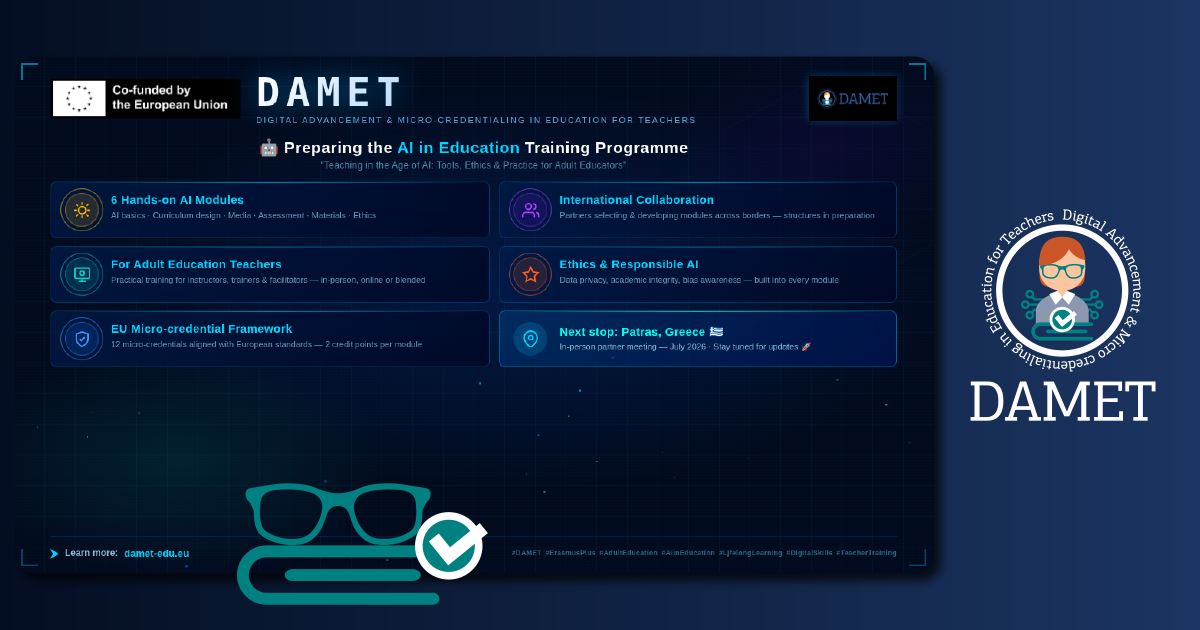
The central output of the project is a course titled «TEACHING IN THE AGE OF AI: TOOLS, ETHICS & PRACTICE FOR ADULT EDUCATORS.» The course is designed to run for three to five days, or alternatively as a series of weekly sessions, and is aimed at teachers, trainers, and instructors working in adult education.
The programme consists of six modules, each lasting two to three hours:
- AI Fundamentals – what AI, machine learning, and generative models are; hands-on demos of tools such as ChatGPT, DALL·E, and Copilot.
- AI and Curriculum Design – using AI to develop learning outcomes, modules, and lesson plans.
- AI and Media in the Classroom – creating visual materials, infographics, and educational videos; recognising the risks of misinformation.
- AI and Student Evaluation – designing tests, rubrics, and feedback with AI assistance; reflecting on bias in automated systems.
- AI and the Creation of Training Materials – generating texts, adapting literacy levels, and personalising content for diverse learners.
- AI and Ethics – data privacy, intellectual property, academic integrity, and developing a classroom AI use policy.
For those wishing to go further, an optional capstone module is planned, in which each participant develops a personal action plan for integrating AI into their teaching practice.
MICRO-CREDENTIALS AND EUROPEAN STANDARDS
The project envisages 12 micro-credentials, meaning each module will carry two credit points. To ensure alignment with European standards, an external evaluator will review the modules and provide guidance on how to adapt them.
The DAMET project is in full swing. And while artificial intelligence keeps moving at pace, the project team is moving right alongside it.
Co-funded by the European Union.
Author: Petja Janžekovič